
English spoken language topics
Download this resource for free
Create an account to access thousands of teacher-created PDFs.
Prepare students for the Spoken Language endorsement component of the GCSE English Language exam with this list of suggested exam topics and question prompts.
What’s included
- FREE printable PDF of the English speaking exam topics
- Editable Word doc version (for subscribers)
Perfect for practice presentations to develop students’ public speaking and spoken English skills and confidence, or for Spoken Language assessments.
Suitable for AQA GCSE English Language, Edexcel English Language, Eduqas WJEC English Language and OCR English Language.
How can students prepare for the GCSE English Language speaking exam?
GCSE English Language students need to develop their debating, presenting, dialogue and speech-writing skills for this non-exam assessment (NEA) in year 10 or year 11.
Here you'll find a choice of 25 English speaking topics designed to engage and interest young people. These challenging, sometimes controversial and highly topical ideas will help to inspire students to plan, prepare and organise their ideas for their spoken presentation and to anticipate answering questions from peers on their presentation and point of view.
With a range of speaking topics to choose from, including politics, climate change, the education system, celebrity culture and freedom of speech, this resource encourages students to choose three topics that interest them, before selecting their favourite.
Looking for more like this?
Get inspired by these 20 teaching ideas for spoken language , explore the full collection of Spoken English teaching resources and lesson materials, or try:
GCSE English Language speaking topics
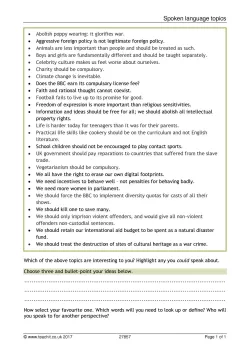
- Abolish poppy wearing: it glorifies war.
- Aggressive foreign policy is not legitimate foreign policy.
- Animals are less important than people and should be treated as such.
- Boys and girls are fundamentally different and should be taught separately.
- Celebrity culture makes us feel worse about ourselves.
- Charity should be compulsory.
- Climate change is inevitable.
- Does the BBC earn its compulsory license fee?
- Faith and rational thought cannot coexist.
- Football fails to live up to its promise for good.
- Freedom of expression is more important than religious sensitivities.
- Information and ideas should be free for all; we should abolish all intellectual property rights.
- Life is harder today for teenagers than it was for their parents.
- Practical life skills like cookery should be on the curriculum and not English literature.
- School children should not be encouraged to play contact sports.
- UK government should pay reparations to countries that suffered from the slave trade.
- Vegetarianism should be compulsory.
- We all have the right to erase our own digital footprints.
- We need incentives to behave well – not penalties for behaving badly.
- We need more women in parliament.
- We should force the BBC to implement diversity quotas for casts of all their shows.
- We should kill one to save many.
- We should only imprison violent offenders, and would give all non-violent offenders non-custodial sentences.
- We should retain our international aid budget to be spent as a natural disaster fund.
- We should treat the destruction of sites of cultural heritage as a war crime.
All reviews
Have you used this resource?
Review this resource18/11/2020
15/03/2018
